Download V1.0.5

LOCAL-FIRST · GENERAL AGENT WORKSPACE

General Agent Work, Legible & Accountable

Meldwork is a local-first General Agent workspace — coordinate research, analysis, writing, planning, review, and implementation across the Agent tools you already run. Shared task snapshots, independent findings, evidence-backed decisions, and a human adoption gate keep every Case inspectable.

One task — across the Agent CLIs you already run.
> 0+ Supported Agent CLIs
* 0 Collaboration Modes
% 0% Local-first work cell
# 0 Human adoption gate

DETECTED ON YOUR MACHINE

Works with the agents you already run.

Meldwork detects a compatible local Agent command and exposes its readiness, capabilities, and session behavior. Approved Agent Connectors can be added through the Agent Connector SDK.

THE SHORT ANSWER

What is Meldwork?

Meldwork is a local-first General Agent workspace for research, analysis, writing, planning, review, and implementation. It freezes task context, captures independent findings as evidence, and puts a human adoption gate before any workspace change.

Supported agents 12+

Codex, Claude Code, Gemini CLI, Qwen Code, Kimi Code, MiMo Code, OpenCode, OpenCodeReview, Hermes, Pi Agent, OpenClaw, WorkBuddy — detected natively on your machine.

Modes 3

Direct · Concurrent Responses · Auto Discussion V4

Review record
Finding → Evidence → Decision → Disposition

Attached to every result — dissent stays visible, never hidden behind a manager.

Runs on

macOS · Apple silicon · Electron

100% local-first work cell

THE WORK CELL

Four steps from task to adopted result.

01

Select

Choose the local Agents and participants. Participants are always selected by you — never auto-assigned from a roster.

02

Scope

Bound the goal, working directory, context, and permissions. Every run starts from a frozen task snapshot.

03

Run

Direct, Concurrent Responses, or Auto Discussion V4 — from a single focused session to negotiated multi-round work.

04

Review & adopt

Inspect findings, evidence, and any Human Gate before the workspace changes. Nothing writes itself.

COLLABORATION MODES

Three ways agents work together.

Same Case, same evidence trail — different depth of agreement. Pick the mode that matches how much review the decision deserves.

>

Direct

One selected Agent keeps its conversation and native session when supported.

Best for focused work with one Agent.
*

Concurrent Responses

Selected Agents receive the same frozen task snapshot and return independent replies in stable order.

Best for comparing approaches before choosing one.
#

Auto Discussion V4

Agents propose, challenge, negotiate responsibilities, execute dependency-aware work, then verify the result.

Best for multi-round work with explicit responsibility.

WHAT YOU CONTROL

Four guarantees that hold the work together.

These four invariants are what make multi-agent output reviewable instead of just decorative.

Human Gate

Workspace writes are opt-in. Nothing changes until you adopt the result — agents don't.

Opt-in workflow controls

Frozen Context

Every run starts from a snapshot. All selected Agents see the same brief, in stable order.

Case-scoped, reproducible

Evidence Trail

Finding → Evidence → Decision → Disposition, attached to each result. Dissent stays visible.

No hidden manager

Local-first Boundary

Electron work cell on your machine. No remote Agent fleet. Conversations stay local.

Your CLI, your data

INSIDE A REAL RUN

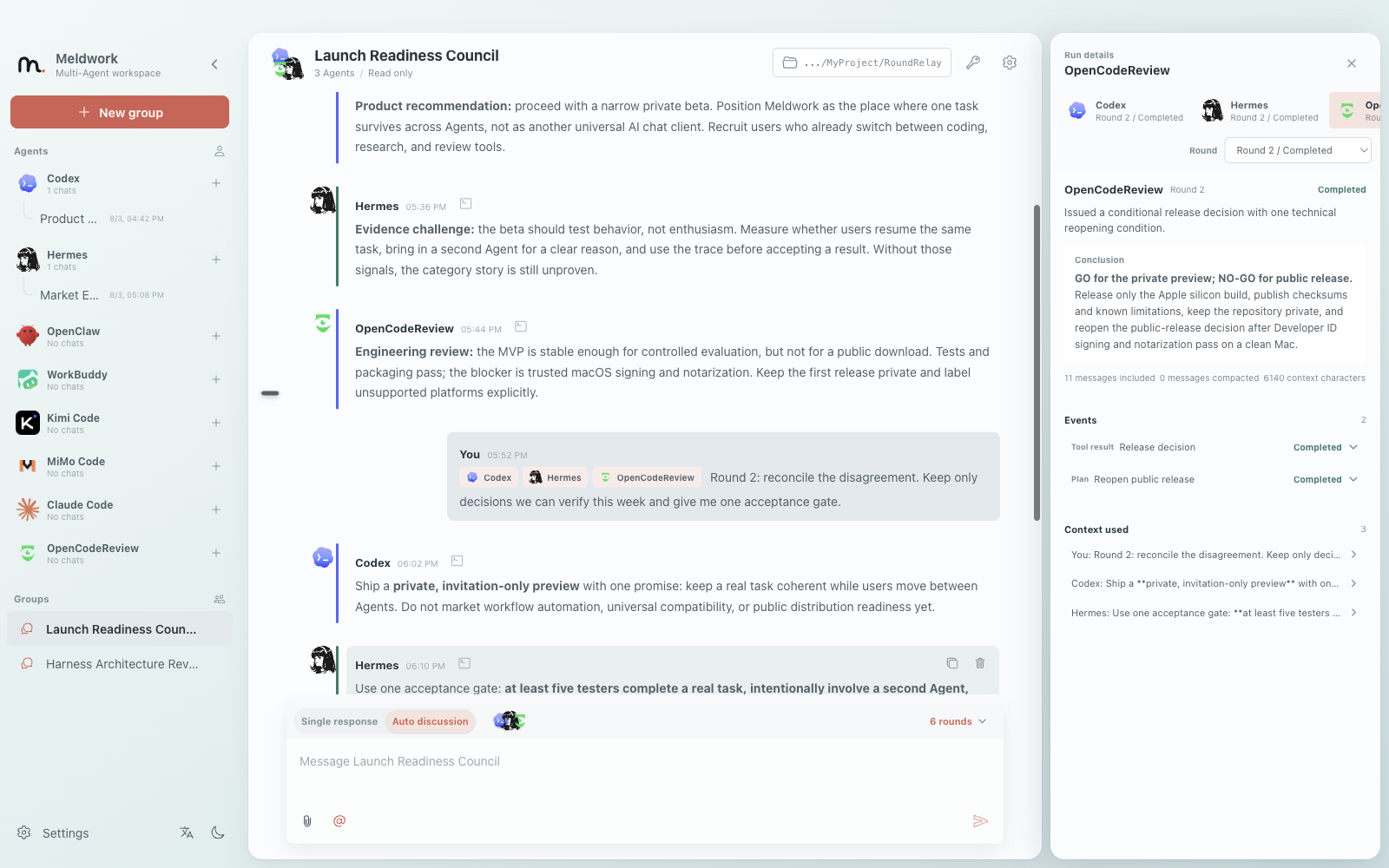
Launch Readiness Council — three rounds, one gate.

Below: the actual evidence from a V1.0.3 session where Codex, Hermes, and OpenCodeReview reviewed a private-beta release decision. Scroll or wait — the timeline advances on its own.

Auto Discussion V4 Launch Readiness Council
Round 1 · Propose
  1. R1 · 05:34
    CodexProposal

    Ship a private, invitation-only preview with one promise: keep a real task coherent while users move between Agents. Don't market workflow automation, universal compatibility, or public distribution readiness yet.

  2. R1 · 05:38
    HermesEvidence challenge

    The beta should test behavior, not enthusiasm. Measure whether users resume the same task, bring in a second Agent for a clear reason, and use the trace before accepting a result. Without those signals, the category story is still unproven.

  3. R2 · 05:44
    OpenCodeReviewEngineering review

    The MVP is stable enough for a controlled evaluation, but not for a public download. Tests and packaging pass; the blocker is trusted macOS signing and notarization. Keep the first release private and label unsupported platforms explicitly.

  4. R2 · 05:52
    YouYouReconciliation

    Round 2: reconcile the disagreement. Keep only decisions we can verify this week and give me one acceptance gate.

  5. Adoption
    Human GateDecision

    Ship V1.0.3 to the private preview only. No-Go for public release. Reopen after Developer ID signing and notarization pass on a clean Mac.

1 / 5

INSIDE THE WORK CELL

Inspectable from discovery to adoption.

Local Agent discovery

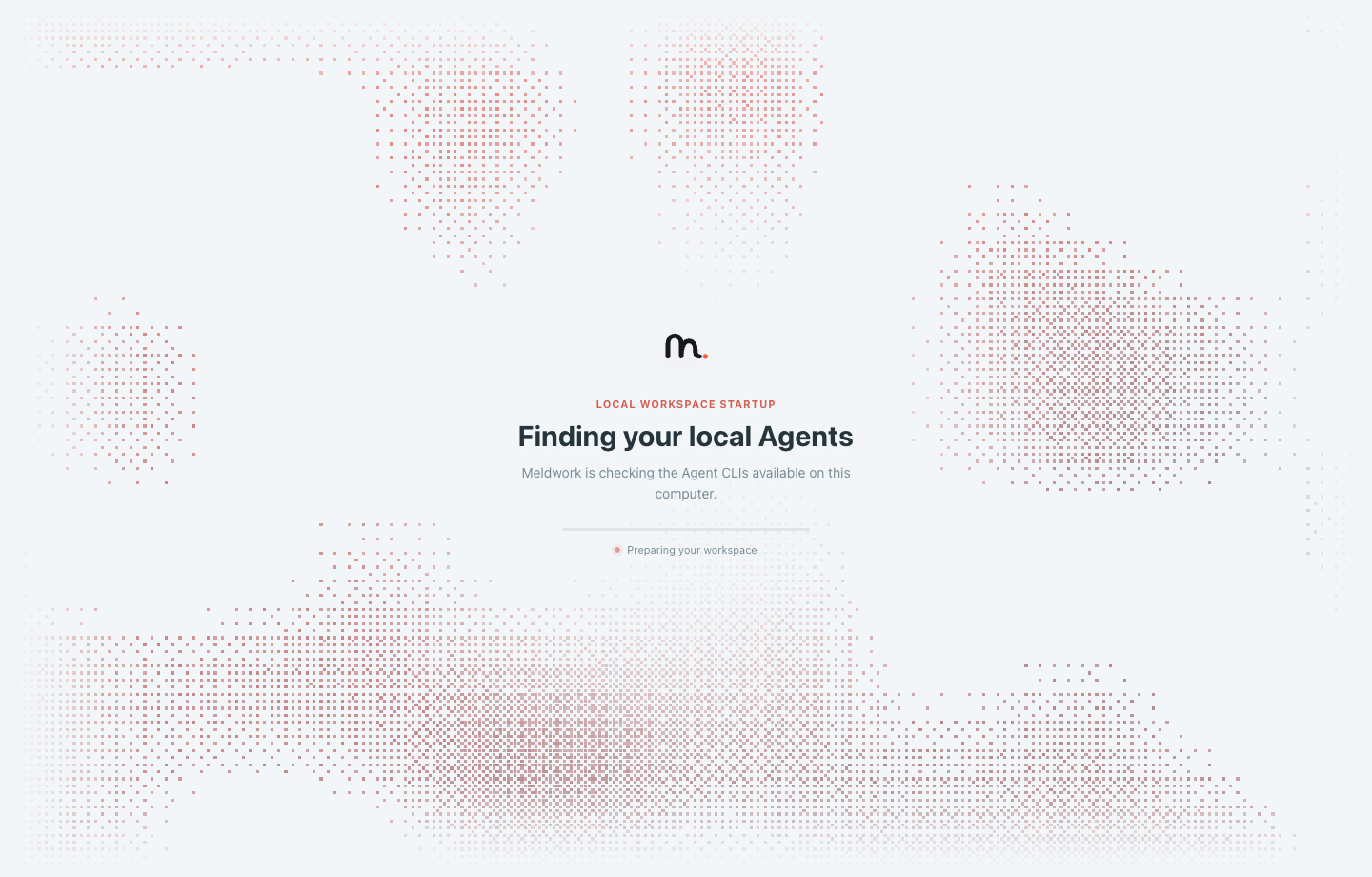
Pick the participants before any work runs. Meldwork detects installed CLIs and shows their adapter status.

Multi-agent review

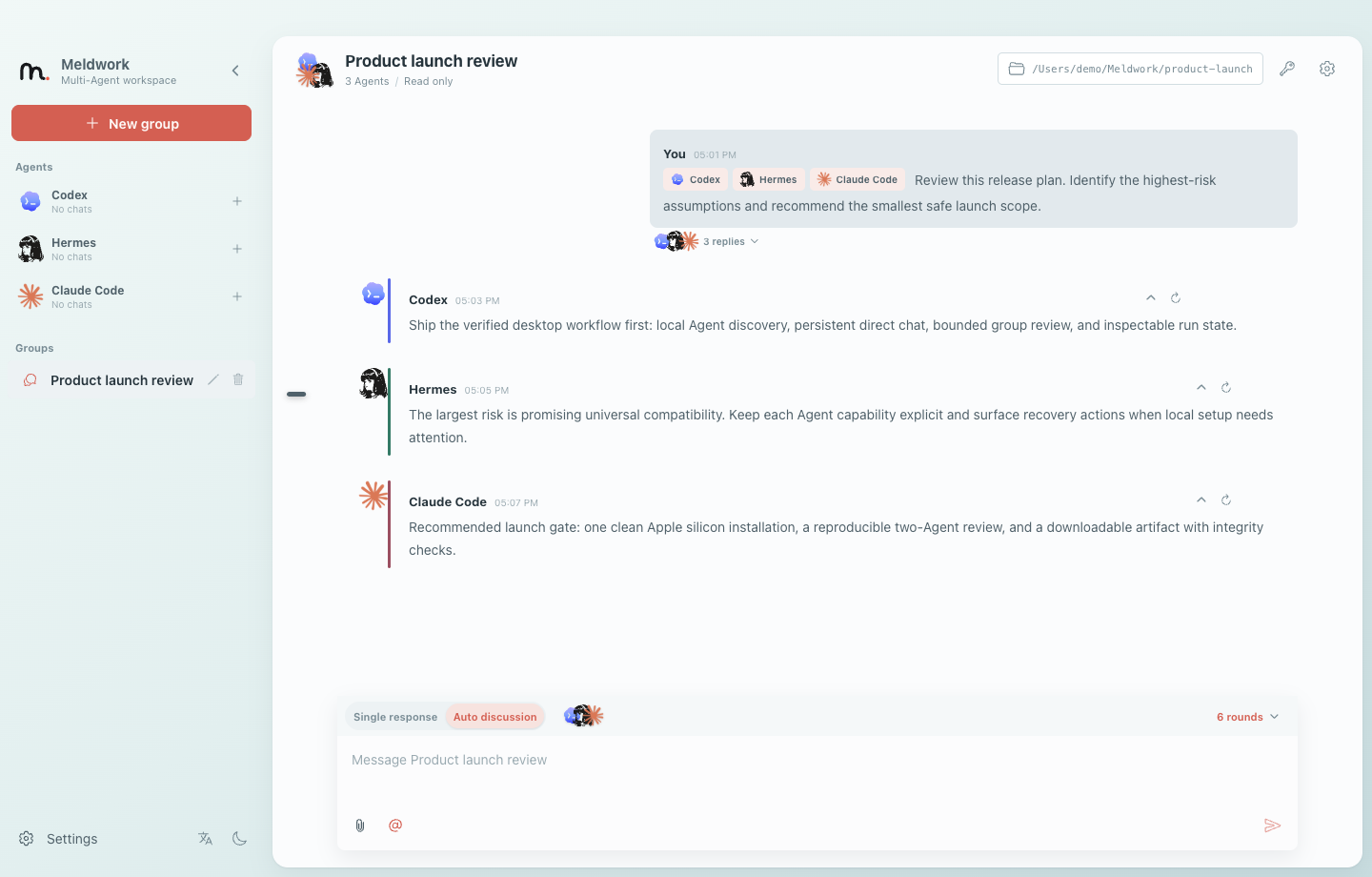
Findings, evidence, and adoption decisions live in one Case. Dissent stays visible — never hidden behind a manager.

Auto Discussion V4

Propose, negotiate, verify — across rounds. Every Agent's position is preserved for later review.

Direct mode

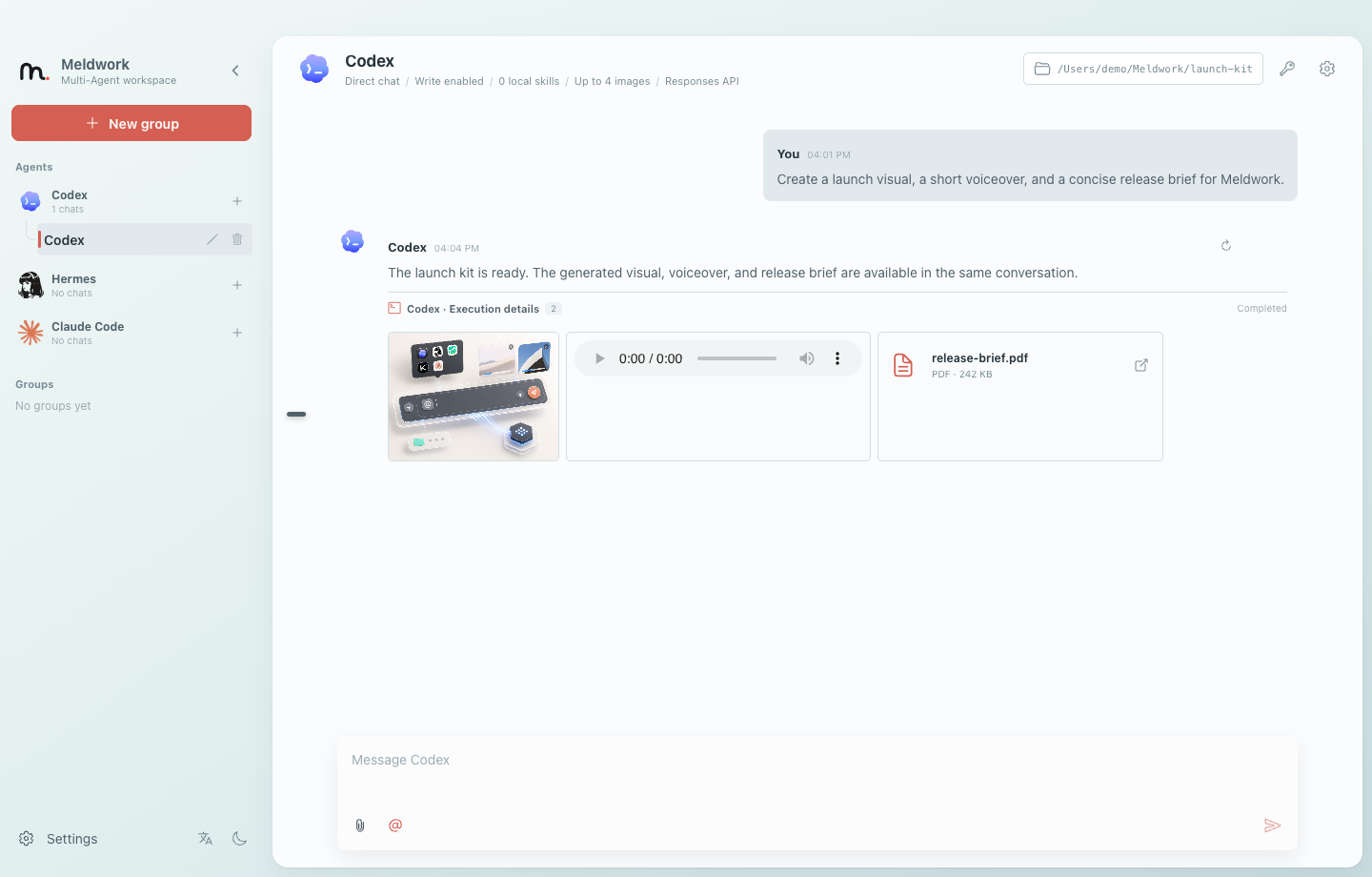
One Agent, its native session preserved. Focused work with the full evidence trail still attached.

Meldwork detecting local Agent CLIs
Local Agent discovery
Multi-agent review with evidence and human review
Multi-agent review
Auto Discussion V4 group collaboration
Auto Discussion V4
Direct multimodal session with local files
Direct mode

Example: give Codex, Claude Code, and Gemini CLI the same task — review a PR, analyze a bug, or compare implementation approaches. Meldwork freezes the task context, sends it to all three agents, captures their independent findings as evidence, and lets you adopt only the result you approve. No manual context copying between terminals.

HOW MELDWORK DIFFERS

A General Agent workspace, not another terminal runner.

Meldwork is a local-first General Agent workspace for macOS. Coordinate research, analysis, writing, planning, review, and implementation across the Agent tools you already run, with no manual context copying between terminals.

WHERE MELDWORK FITS

How Meldwork compares to other Agent workspaces.

A condensed map of how Meldwork positions itself next to terminal runners, cloud fleets, communication networks, and framework-based orchestrators like CrewAI, LangGraph, and Claude Code Agent Teams. Full per-project comparison lives in the README ↗.

Category
What it focuses on
Meldwork's difference
Terminal / IDE runners
tmux, zellij, Claude Code, Codex CLI
Run a command, view output, navigate worktrees. Manual context copying between agents.
Adds evidence-backed review, frozen task snapshots, and a human adoption gate on top of the same CLIs.
Cloud Agent fleets
Devin, Factory, OpenHands Cloud
Hosted sandboxes, remote execution, multi-tenant routing.
Local Electron desktop app using the CLIs already installed on your machine.
Agent communication networks
Buzz, MCP Agent Mail
Identity, channels, events, persistent collaboration.
Case-scoped independent judgments, each attached to evidence and a Decision / Disposition.
Parallel coding workspaces
Conductor, Claude Squad, amux, Emdash
Multiple workspaces, parallel Agents, and merge queues.
Review across heterogeneous CLIs — not just worktree throughput or parallel execution.
Multi-Agent frameworks
CrewAI, LangGraph, AutoGen, Claude Code Agent Teams
Graphs, routing, approvals, and DSLs you build yourself. Agent Teams only works within Claude Code.
A ready-to-use desktop workflow across 12+ heterogeneous CLIs — no orchestration framework to assemble.
THE BOUNDARY

What Meldwork is, and isn't.

Is

  • A local-first Electron app for desktop review workflows.
  • A work cell that orchestrates the Agent CLIs you already have.
  • An evidence-first review record (Finding → Evidence → Decision → Disposition).
  • Workspace writes as opt-in workflow controls.
  • Source-available under the Meldwork Non-Commercial Source License 1.0.

Isn't

  • Not a hosted Agent fleet or general Agent framework.
  • Not automatic participant selection from a larger roster.
  • Not enterprise SSO / RBAC / governance tooling.
  • Not an operating-system sandbox — writes happen through your shell.
  • Not fully offline — a selected Agent may send prompts to its configured Provider.

ANSWERS

Questions teams ask before adopting.

Short, honest answers — the long versions live in architecture.md ↗.